White Fox Marvel Rivals: Forms, Controls & Crosshair
Source review: 12 October 2026. This is a source-based form and control reference with editorial practice suggestions. It does not claim measured healing, win rates or a best sensitivity.
White Fox is a Strategist whose active form changes the task your controls perform. Compare support targeting and melee movement separately. A reticle that you can locate comfortably is useful, but it does not replace recognising the form, resource state and ability currently available.
Use a form-based ability reference
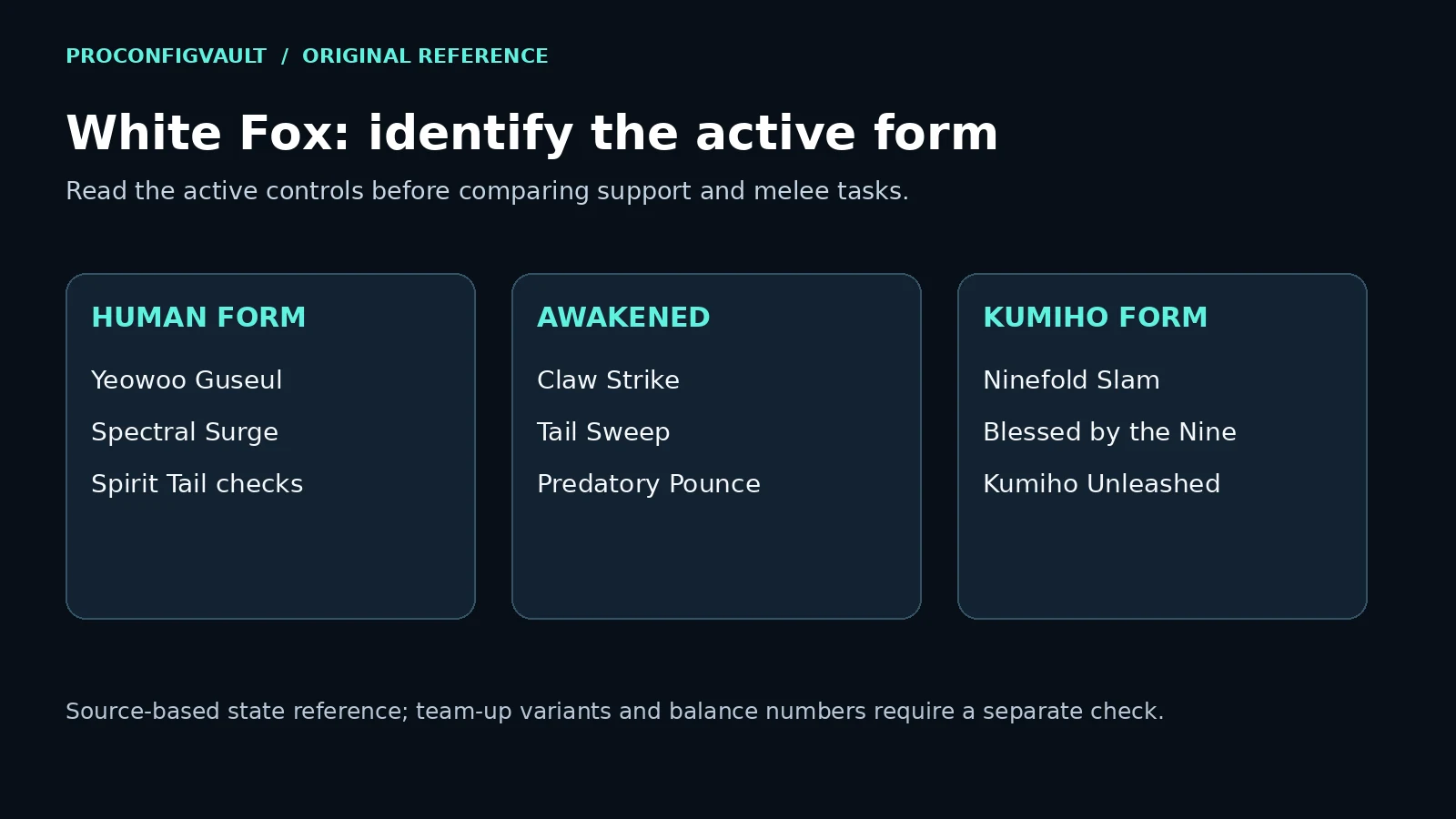
| State | Core names in the official reference | What to identify |
|---|---|---|
| Human form | Yeowoo Guseul, Spectral Surge, Spirit Sanctuary | Projectile support, Spirit Tail resources and ally selection. |
| Awakened state | Fox Form Awakening, Claw Strike, Tail Sweep, Predatory Pounce | A different melee and movement task with nearby healing. |
| Kumiho form | Kumiho Unleashed, Ninefold Slam, Blessed by the Nine | The ultimate form and its ally-support controls. |
The official reference links Yeowoo Guseul to damage, healing and Spirit Tail restoration. Fox Form Awakening uses that resource and changes the attack set. Kumiho Unleashed has its own form controls and restrictions. Read the current client descriptions before copying a fixed button sequence from another setup.
Why a form change matters for settings
A support-targeting exercise and a turning exercise test different parts of your setup. If you evaluate only a stationary target, you have not checked whether you can locate an ally or orient yourself after a movement action. If you evaluate only a close-range fight, you have not checked whether the reticle remains easy to place during the support task.
Keep a small log for each form. Record the state first, then the intended action, whether the target was acquired, and any repeated mouse correction. This helps distinguish a difficult control transition from a visibility problem. The log is an editorial comparison method, not a claim that one form or playstyle is always optimal.
A two-task reticle and sensitivity comparison
- Save your baseline. Record reticle, sensitivity, active form and team-up selection.
- Repeat a support-targeting task. Use the same ally/target arrangement and note whether you locate the center consistently.
- Repeat an orientation task. Use the same start and intended end direction in the form you are checking.
- Compare one reticle change. Keep sensitivity steady while trying a color or outline adjustment.
- Compare sensitivity separately. Restore the chosen reticle, make one small input change and repeat both tasks.
Use the hero-specific controls provided by your current Marvel Rivals client. Test a small cross against a dot at a similar size. If either disappears against the practice surfaces or effects, try an outline and repeat. Do not label a copied VALORANT profile string as a Marvel Rivals import code.
A good note records what happened rather than just the final score. “Lost the center during the turn” points to a visibility check. “Selected the wrong state before using the control” points to a form-recognition exercise. Different observations call for different experiments.
Watch resource use and ally position together
Before a test, read the current resource display and choose the support task you intend to perform. Afterward, record whether the expected action was available and whether the intended ally was still accessible. Changing sensitivity cannot answer why a resource-dependent action was unavailable.
If you move toward a close-range task, keep a note of which allies you intended to support and where the action leaves you. Repeat that same arrangement before judging a settings change. This keeps a comparison tied to the hero’s combined control tasks rather than to a single easy target.
Use dated patches for numerical claims
White Fox’s healing and resource-related details have changed in dated publisher updates. The May 15 bulletin adjusted the balance between continuous and attack-triggered healing during Fox Form Awakening. That is a reason to check source dates when a guide quotes healing numbers; it is not a new measurement by this website.
The September 11 bulletin also changed healing and damage conversion to ultimate energy for Strategists as a group. A guide about ultimate timing must account for the relevant patch rather than assuming an old routine charges at the same rate. The October 9 balance bulletin was reviewed as part of this source check.
This page deliberately leaves unverified current damage, healing and cooldown figures out of its recommended settings. Where a build guide needs those numbers, record the client version, source and relevant team-up before presenting the sequence as tested.
Team-up variants need their own notes
Confirm the selection that is active in your client. Do not add all conditional effects from a hero reference to the base kit. If the selection changes resource use or an ability’s availability, repeat the affected task and record it separately from the original baseline.
A source-based role guide and a measured combo guide require different evidence. This guide provides the form reference and comparison method. It does not claim a dataset of ranked matches or a best team composition.
Common questions
What role is White Fox?
The official game page classifies her as a Strategist.
Why does the same control perform another action?
First check the active form and client description. The official reference lists different attacks and abilities across her states.
Does a larger crosshair solve form confusion?
A reticle change tests visibility. Recognising the form and available controls is a separate task to practise.
Sources and related guides
Role and form reference: official White Fox hero page. Dated healing change: version 20260515 balance post. Strategist energy conversion: version 20260911 bulletin. Recent review: version 20261009 bulletin.
For the wider roster, use the characters guide. Check the patch hub before following an older setup, and use the reticle collection to explore styles after you have identified your control task.